4 min read
The Cover Curio
The village whose beach was taken away
On the night of 26 January 1917 an easterly gale met a spring tide at Hallsands, a fishing village of stone cottages wedged onto a rock ledge in South Devon. By eight in the evening waves were breaking at roof height. Four houses went that night. All seventy-nine residents survived — the children had been evacuated beforehand, and the rest got out during a lull in the storm at low tide; nobody died; by the time the sea finished, exactly one cottage was still habitable.
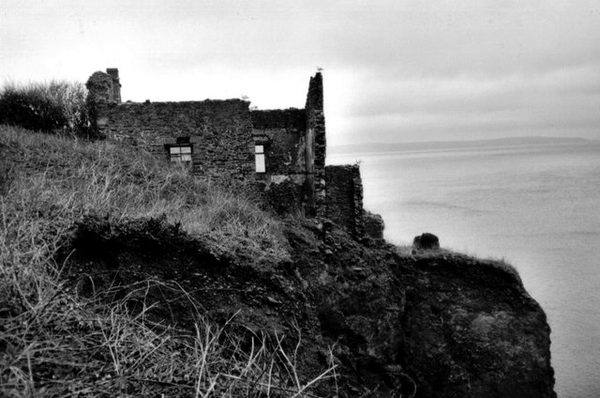
The village had stood there for centuries because a bank of shingle stood in front of it. The villagers grasped the danger; officialdom did not accept until 1918, after the village was gone, that the shingle was an inheritance, not an income. About forty percent of it is flint and chert and about forty-six percent quartz, roughly eighty-six percent between them — and there is no flint or chert anywhere in that coastline. The stones were shoved ashore by a rising sea thousands of years ago and have been shuffled back and forth in a closed system ever since (SCOPAC).
From April 1897 the Admiralty’s contractor dredged that bank for concrete aggregate to enlarge Devonport dockyard — as much as 1,600 tons a day, roughly 650,000 tons before the licence was pulled in January 1902. The firm insisted the sea would put it back. Instead the sea filled the dredge holes using the beach itself. The beach fell somewhere between ten and twenty feet, depending on whose survey you trust, and the low-water mark ended up inland of where high water used to reach (Maritime Archaeology Trust; SCOPAC; BGS).
It has never come back. Start Bay is still redistributing shingle within its closed cell, and Hallsands is still eroding (SCOPAC).
A 2017 retrospective renders the Kingsbridge Gazette‘s January 1917 front page as saying that the beach went to Devonport and the cottages went to the sea; a companion piece gives the last words as “the villages went to the sea” — the original front page has not been consulted, so the exact wording remains unverified.
7 min read
The Grimoire
The mould war that remade sake
On the thirteenth day of the fourth lunar month of 1444 — May 14 in Western reckoning — the shogun’s deputy Hatakeyama Mochikuni sent troops against a shrine in the northwest of Kyoto. The people inside had barricaded themselves in. When it was over, most of Kitano Tenmangū’s buildings had burned and the shrine went into decades of decline.
The war was about who was allowed to grow a mould.
Rice is starch, and sake yeast cannot eat starch. What bridges the gap is Aspergillus oryzae — kōji. You scatter its spores over steamed rice, keep it warm and wet, and over two days the mould threads into every grain and floods it with enzymes that cut starch into sugar and protein into amino acids. No kōji, no sake. Also no miso, no soy sauce, no rice vinegar, no mirin. Whoever controls the mould controls the entire pantry.
Kyoto’s kōji makers were attendants of Kitano Tenmangū, holding the tax-privileged jinin status that came with shrine service (Tokyo Foundation). They organised as the kōji-za, bought a monopoly from the Muromachi shogunate, and brewers in the capital were forbidden to make their own. A register of brewers kept at the shrine in 1425 counts about 342 of them in and around Kyoto (Japanese Wiki Corpus). A large market, and an unwilling one — though the wealthiest were already making their own.
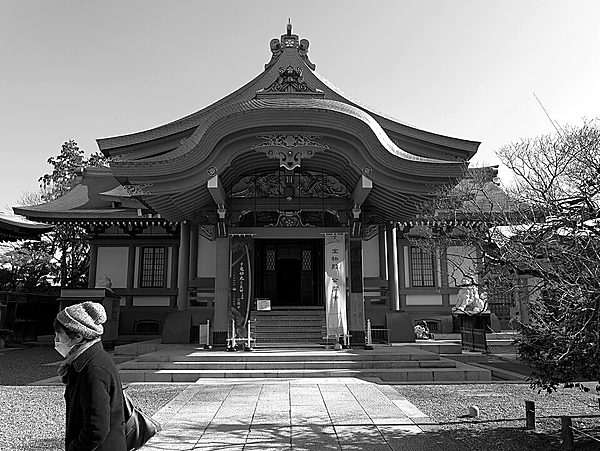
They broke it in 1444. The brewers had money, and Enryakuji sided with them; the shogunate, which had granted the monopoly, sent troops against the shrine, and the guild submitted (Nippon.com). The guild lost its monopoly, the trade in finished kōji in Kyoto went into steep decline, and kōji-making was swallowed into brewing as one more step in the brewhouse.
A few of the beaten makers, according to the family that runs Kyoto’s last seed house, survived by changing what they sold. Not kōji — seed. Nobody can document the switch, and the trade itself was older than the war: Yamato had spore sellers by the early thirteenth century (Kotobank).
Here is the whole trick, and it is better than it sounds. A brewer’s kōji and a seed-maker’s kōji are the same organism run to opposite ends. The brewer pulls his after forty to sixty hours, deliberately before the mould flowers, because that is when enzyme output peaks and the grains still taste sweet. The seed-maker lets his run the better part of a week, well past useful, until every grain is furred yellow-green with spores. One wants the factory. The other wants the seed.
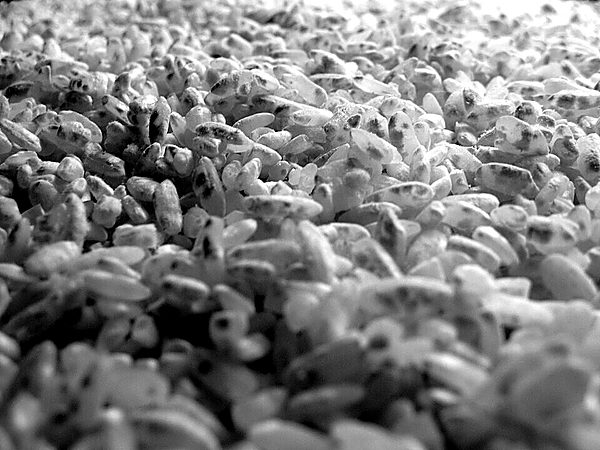
What makes the second possible is ash. Hardwood leaves burned all the way down to white ash, about a tenth to a half of a percent of it stirred into the steamed rice. It does three jobs at once. The alkalinity it creates is intolerable to competing bacteria and moulds, and tolerable to oryzae. The potassium and phosphorus in it drive the mould to sporulate hard. And the dry powder keeps the grains from clumping, so the dried seed kōji keeps its grain form or can be sifted to powder — packed into paper bags, layered with more ash between them in a box, stored and shipped (Machida, Yamada & Gomi, DNA Research, 2008; Yamashita, Journal of Fungi, 2021). A selective medium, a fertiliser and a preservative — worked out by trial and error at some date nobody can now fix, probably centuries before anyone had seen a microbe.
The houses guarded it as families. One Kyoto seed dynasty, the Ōmiya, kept a manual called the Geppō Densho; by the middle of the Edo period they already knew that different seed stocks changed the finished product (SAKE Street). That is what a moyashiya actually sells. Not mould — sameness. A modern one runs its growing room at 30°C and 98% humidity and guarantees a 95% germination rate (Nippon.com).
And the thing they were holding still was never still. A. oryzae sits inside the A. flavus clade, and A. flavus makes aflatoxin, among the nastiest liver carcinogens known. Oryzae has no record of making any. In some strains most of the toxin gene cluster is deleted; in others it is nearly intact but broken. When 82 industrial strains were sequenced, the broken clusters did not sort by toxigenicity — the detoxification looks to have happened in parallel across oryzae and flavus (DNA Research, 2019). Nobody can say whether centuries of men picking the batch that made good sake bred the poison out, or whether the guilds happened to catch lineages that had already dropped it. Either way, the heirloom was being quietly edited under them the whole time, by people with no word for what they were editing.
A trade list from around 1953 names thirty seed houses. There are about ten now. Hishiroku, the last one in Kyoto, cannot date its own founding — a rival’s document names it by 1769 — and supplies some two thousand clients.
The guild lost the war. The trade that outlasted it — whether or not the same families carried it — had given up the product and sold the one thing nobody could copy off them: the ability to start again from nothing.
10 min read
The Long Read
The last flight of USS Macon
The channels were still in the rack by the shop door at Sunnyvale, tagged in my own handwriting. Eight lengths of duralumin, drilled and countersunk, waiting to go into the ring at frame 17.5 where the top fin met the hull. Three of the four fins had already had theirs fitted. The upper one needed a man working from inside the gas-cell space, which meant deflating a cell, which meant a yard period we didn’t have, so the channels sat where I saw them every morning on the way in, and the ship went to sea without them.
I was an aviation metalsmith, second class. My job was the skin of a flying building. Seven hundred and eighty-five feet of it, hollow, with three keels running the length like the galleries of a mine, and twelve gas cells hanging in their nets overhead — great gelatin-latex bladders full of helium, breathing in and out with the weather. Walk the lower keel from bow to tail and you have gone the length of two and a half city blocks without touching the ground.
Everything aboard was weight, and weight was the only thing anybody argued about. That is the part nobody on the ground ever understood. A ship like ours did not fly by lift the way an airplane does; she floated, and floating is a balance you have to keep paying for. Burn a ton of gasoline over the Farallones and you are a ton lighter, which sounds like good news and is not: light means rising, and rising means the helium in the cells swells, and when it has nowhere to go, the automatic valves open and it leaves. Helium came out of a government field in Texas and cost real money, and the Navy would sooner have lost a cutter than a cellful. So the exhaust from all eight Maybachs ran through condensers, and we caught the water out of our own smoke and pumped it into ballast bags along the keel — a machine whose whole purpose was to turn burnt fuel back into weight. When she was trimmed right you could push a two-hundred-ton airship with one hand.
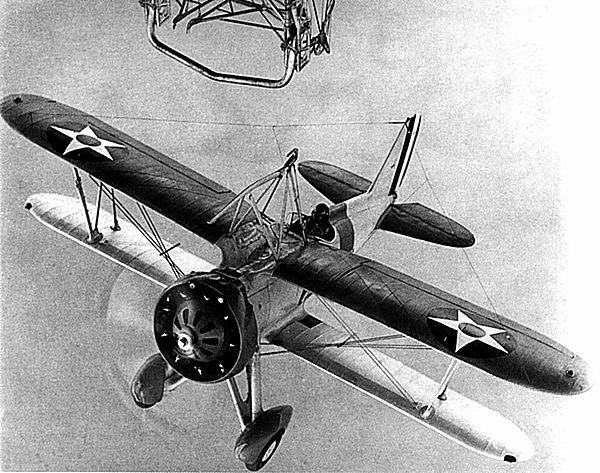
That last afternoon, the twelfth of February, we took the airplanes back aboard off the Big Sur coast. I never got tired of watching it. The trapeze came down out of the T-shaped slot in the belly, and a Sparrowhawk climbed up into our wake, and the pilot flew formation on a moving cave. They took the wheels off those planes when they lived with us and bolted a fuel tank on instead — no wheels, nothing to land on, the ship was the ground. Two signalmen lay in the opening and talked the pilot in with their hands. He came up under the bar at sixty-five, seventy miles an hour with the slipstream punching him around, touched the hook above his top wing to the crossbar, and the catch took him automatically. Then he cut the engine, and the whole airplane went silent and swung, and we winched it up inside and put it on the rail like a coat on a hook. Boyce had it that day. He climbed down grinning as usual and said the air was going to be filthy by the Point.
It was. We came up on Point Sur at about five in the evening with a squall on the port bow, and the ship began doing the thing she did in rough air, which was flex. You could stand in the keel and watch the girders work like a wicker basket. Then there was a report from aft — not an explosion, a single hard crack, the sound a big bone makes — and the deck rolled and I was against the netting.
I went aft with two other men. You could see it before you got there because there was daylight where daylight had no business being. The upper fin was gone. Torn away, and it had taken a section of the ring with it, and broken girders had gone through the three after cells like a hand through a paper bag. The cells were emptying. You could hear it, a sound like a room full of people all breathing out at once, and you could feel it in the deck, because the tail was becoming heavier than the rest of the ship and the whole seven hundred and eighty-five feet was tipping up by the bow.
The captain did what he had to do. Slip the ballast — everything aft, all at once, tons of water out of the bags and into the ocean, to get the tail up.
It worked. That is the awful part. It worked so well that we went up like a cork, past seventeen hundred feet, past twenty-eight hundred, and twenty-eight hundred was our pressure height. Above that the helium in every cell in the ship expands harder than the air outside can hold it, and the automatic valves lift off their seats, and there is nothing on earth you can do about it. We climbed to nearly five thousand feet with the valves singing, and by the time she stopped climbing we had thrown away the water we could never get back and vented the gas we could never get back, and everybody on that keel who understood the arithmetic understood that the ship was already over. We were just going to be a while getting there.
Twenty minutes, as it turned out. That is a very long time. It is long enough to get the rafts out and long enough to put on a life jacket, and the reason there were life jackets on that ship is that the Akron had gone into the sea off New Jersey two years before with none aboard and one raft, and seventy-three men had died in the water in April. Our captain had been in that water. He had been the executive officer of the Akron, and he was pulled out unconscious, and he was one of three men who came home. So we had jackets, and we had drilled, and when the Macon finally sat down on the Pacific tail first, stern already under, bow standing up out of the swell in the dark, we went off her in reasonably good order and floated in the oil and waited for the cruisers.
Two men didn’t come home. One jumped while the ship was still too high and hit the water from a height a body cannot survive. The other was last seen still aboard her, up in the wreckage, and he did not come out. Eighty-one of us did. The cruisers had us aboard within the hour, and I remember somebody handing me coffee and my hands not working well enough to hold it.
The ship is still where she landed, in about 1,450 feet of water off Point Sur. Nobody could find her for fifty-five years — until a fisherman brought up a piece of girder in his net and someone recognised what it was. There are four Sparrowhawks down there in the mud, wings and cockpits and gun sights, the star insignia still readable on the fabric, and the little sky-hooks above the top wings still reaching up for a bar that isn’t there.
I think about the eight duralumin channels in the rack by the shop door. They were the right parts. They were cut and drilled and correct. Being right is not the same as being installed.
Author’s note: The airship is real and so is nearly everything here. USS Macon (ZRS-5) — 785 feet, twelve helium cells, eight Maybach engines, condensers that recovered ballast water from her own exhaust — went down off Point Sur on 12 February 1935 after her unreinforced upper fin carried away in rough air; the duralumin reinforcement of frame 17.5 had been completed on three fins and deferred on the fourth. Ballast was dropped, the ship shot above her 2,800-foot pressure height to roughly 4,850 feet, valved helium she could not replace, descended to the ocean about twenty minutes later, and floated for roughly forty minutes more before sinking. Of the 83 aboard, 81 lived, largely because the Navy, after the USS Akron disaster of 4 April 1933 — 73 dead, no life jackets aboard — issued this ship jackets and rafts; her captain, Herbert V. Wiley, had himself survived that crash. The two who died were Radioman 1st Class Ernest Dailey, who jumped too soon, and Mess Attendant 1st Class Florentino Edquiba, who was last seen aboard the sinking ship — accounts of why he stayed differ. Boyce and the narrator are invented; the trapeze, the missing wheels, and the signalmen in the T-shaped hatch are not. The wreck was located in 1990 after a fisherman’s net snagged a girder, and has since been surveyed by NOAA’s Monterey Bay National Marine Sanctuary and MBARI, whose cameras found all four Sparrowhawks, with a Navy star still visible on surviving fabric from at least one; it is now on the National Register of Historic Places.
5 min read
Practical Arcana
How a moving truck bends a frozen lake
In the winter of 1974–75 a team of engineers drove a fleet of trucks onto Lake Diefenbaker in Saskatchewan on purpose. Vehicles from 2.2 to 23.5 tonnes, ice between half a metre and three-quarters of a metre thick, a measured track 305 metres off the ferry crossing near Riverhurst, runs up to 31 m/s — a shade over 110 km/h, on a lake. They weren’t trying to sink anything; they were watching how the ice moved underneath. What D. Eyre reported in the Journal of Glaciology is the part worth carrying around: in a handful of measurements he called incomplete, mostly with heavy vehicles, the ice cracked hardest not on the fastest runs, but at about 85 percent of the speed theory called critical.

Here’s why speed matters at all on something that looks like ground. Lake ice isn’t ground. It’s an elastic plate floating on water, and anything standing on it sits in a shallow dish of its own making. Drive, and the dish travels with you — which means you are driving a wave through the water below, with a sheet of ice riding on top of it. Water waves have a preferred speed. Match it, and the dish stops merely travelling with you and starts building, because the load is now moving exactly as fast as the slowest waves it can make, so their energy piles up underneath instead of dispersing away. That threshold is the critical speed, and it is not a fast number. In a field experiment at Lake Saroma in Hokkaido, with 17 cm of ice over 6.8 m of water, it came out around 6 m/s — about 21 km/h. A snowmobile does that in second gear.
The rule that falls out of this is the one nobody expects: critical speed drops as the water gets shallower. Shallow water is the dangerous water. Published ice-road limits run from about 6.5 km/h on very shallow lakes to 24 km/h on ordinary ones and 35 km/h on deep ones, which is the same physics wearing a road sign. So on a crossing, the mid-lake deep water is the forgiving part; the shoals and the last hundred metres before shore are where your wave is slowest and your ice is most cracked and hinged. Obey the posted limit, and stay slow through the shallows in both directions. Keep a low, steady speed on the approach and avoid unnecessary sudden acceleration or braking — but slow or stop when a hazard, a sign or the ice-road operator requires it. Don’t let your wave meet an oncoming vehicle’s — northern haul roads separate the lanes and swing the shore approach off-square for exactly that reason. And note Eyre’s tentative finding: you cannot outrun the band by flooring it, since the worst cracking he measured happened below critical, on the way through.
For short-duration loading, the arithmetic is Gold’s formula, from Canada’s National Research Council: P = Ah², load in pounds, thickness in inches. Minnesota’s DNR uses A = 50 and publishes the resulting table — 4 inches to walk, 9 to 10 for a small car, 13 for a medium truck, 17 for a heavy one. Two corrections that do the real work: white ice, the refrozen-slush kind, is about half as strong as clear ice, so double every number; and parked vehicles should sit at least 50 feet apart and be moved every two hours — sit longer and you’re on the DNR’s separate, thicker stationary table — because a stationary load keeps pushing its dish down long after you’ve stopped thinking about it.
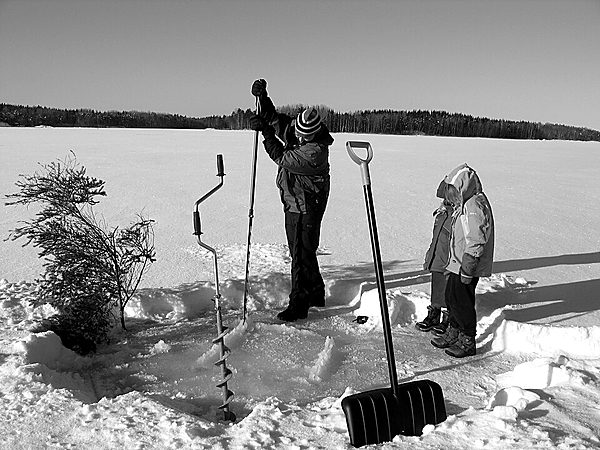
Now the honest part. Gold’s formula was fitted to breakthrough observations, not derived from first principles, and it assumes sound ice, uniform thickness, still water. It tells you nothing over current, near an inlet or outlet, around springs, near aerators, or in late-season candled ice where thickness has stopped meaning strength. Ice can be two feet thick in one spot and an inch thick twenty yards on, which is why you drill repeatedly along a route instead of once at the bank. And the guidelines themselves aren’t as settled as they look: a 2015 review by the NRC’s Paul Barrette, presented to the Transportation Association of Canada, found that Canadian ice-road guidance disagrees substantially on how much to discount white ice, producing large discrepancies in the maximum loads different jurisdictions will sign off on.
Which is the thing to remember when you step out onto a frozen lake: it is holding you up because it is floating. And floating means moving.
6 min read
A Question You Can't Put Down
When evidence works before explanation
On 20 May 1747, in the forehold of HMS Salisbury, a naval surgeon took twelve men who all had scurvy — same rotting gums, same bruised shins, same gruel and mutton broth — and split them into six pairs. One pair got cider. One got twenty-five drops of elixir of vitriol, three times a day. One got vinegar. One got seawater. One got a medicinal paste of garlic, mustard seed, radish root, balsam of Peru and myrrh. One got two oranges and a lemon a day.
The citrus pair recovered. One of them was fit for duty after six days; the other was well enough to be made nurse to the rest of the sick.
The consequence was, that the most sudden and visible good effects were perceived from the use of the oranges and lemons […]
— James Lind, A Treatise of the Scurvy (1753), Internet Archive
Then the Navy took forty-eight years to act on it.
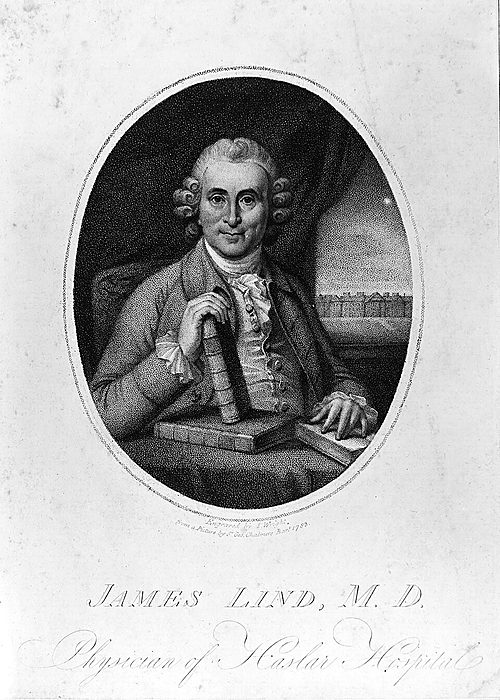
The version everyone tells is that the Admiralty were fools who sat on a proven cure while thousands of sailors died. That version has a hole in it, and the hole is Lind. He called oranges and lemons the most effectual remedies at sea, but never settled on citrus as the cure. He blamed scurvy on damp air, confinement and faulty digestion, listed a dozen remedies, and buried the trial in a few pages of a four-hundred-page book that was mostly a literature review. Worse, the practical form he recommended — fruit juice boiled down to a portable syrup he called a rob — has since been shown to contain essentially no vitamin C at all. The man holding the evidence was the man refusing to lean on it, and the historian Iain Milne argues he refused because he would not push a remedy whose mechanism he could not explain.
So: was that scruple a virtue or a body count?
The case that it was a body count is easy. Twelve men, controlled for diet and quarters, one variable swapped — that was more systematic evidence than eighteenth-century medicine usually produced about anything. Scurvy killed more British sailors than the French did. If you demand a mechanism before you act, you are buying philosophical tidiness with corpses, and the price is paid by other people.
The case for the scruple is harder and better. In 1747 the world was full of cures that worked. Malt wort worked; Sir John Pringle, president of the Royal Society, said so. Fresh air worked. Vinegar worked. Every one had testimonials from sober men. A captain in 1760 was not looking at one proven cure and eleven duds; he was looking at twelve claims of the same shape, and twelve men on one ship is not much of a tiebreak. Lind’s caution wasn’t obstruction. It was the correct response to a field where everything worked and nothing did.
And here is where it stops being a tidy morality tale. The Navy eventually ignored the scruple. Gilbert Blane and Thomas Trotter pushed lemon juice through in 1795 on the strength of the numbers and a voyage on which emerging scurvy was checked with extra lemon juice and the crew reached port free of it, nobody understanding why, and naval scurvy all but vanished — one of the great public health wins in history, achieved on a fact nobody could explain.
Which meant nobody could tell when it stopped being true.
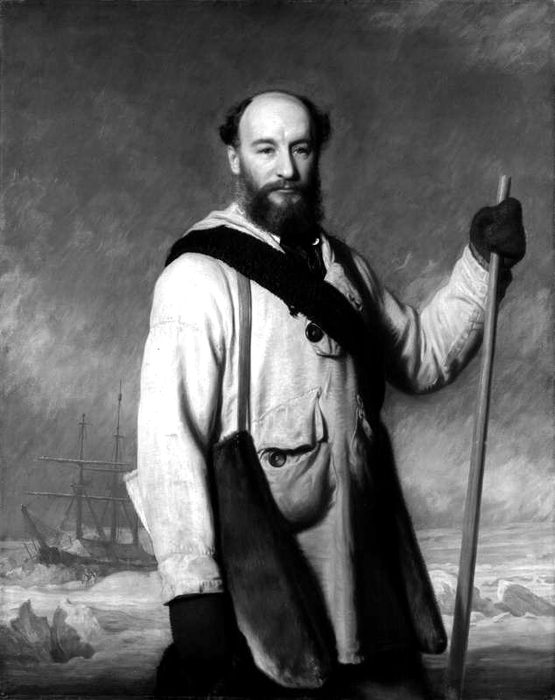
Around 1860 the Admiralty switched from Mediterranean lemons to West Indian limes — cheaper, and grown inside the Empire. Fresh lime juice has roughly a quarter of the punch, and the stuff issued to ships stood settling in tanks, open to the air, and was pumped through copper piping, which destroys most of what remained. In 1875 George Nares took 120 men north with lime juice in the holds and none in the regular sledge ration. Within a month of the spring sledging, a third of the party had scurvy; by June only nine of the fifty-three men aboard Alert were fit. The Admiralty inquiry blamed the missing sledge ration, but confidence never recovered, and over the following decades influential voices drew another conclusion: citrus doesn’t prevent scurvy after all. Jackson and Harley pushed tainted tinned meat instead; Almroth Wright proposed acid intoxication of the blood. One of Scott’s surgeons, Edward Atkinson, carried that theory to Antarctica.
The anchor had been dragging for fifteen years and nobody could feel it, because nobody knew what the anchor was gripping. It took Holst and Frølich in 1907, who happened to pick the guinea pig — one of the few mammals that can’t make its own vitamin C — to get the ground back.
Here’s what you can’t put down. A belief you can use but cannot explain is not half-knowledge; it’s knowledge with no immune system. When it fails, you have no way to distinguish our supply went bad from we were wrong all along. The Navy was right for sixty-five years without knowing why, and that ignorance cost nothing until the day it cost everything.
So which do you want holding your life up — the thing that works, or the reason it works? You will not usually get both. And you will not be told which one you’re standing on.
5 min read
Out of Your Lane
The boulder that proved glaciers move
In 1827 or 1829 — the sources disagree — a theology-trained naturalist from Solothurn named Franz Joseph Hugi built himself a hut on a glacier (Stadtgeschichte Grenchen). Not beside one — on one, a stone shelter propped against a big boulder sitting on the medial moraine of the Unteraargletscher in the Bernese Alps. He came back a few summers later and it was in the wrong place. He came back again and it had moved further. He reported that between 1827 and 1836 his house travelled about 1,315 metres down the valley (Journal of Glaciology), though he was sighting by eye against distant peaks and nobody should trust the last two digits. The Swiss Alpine Club’s account of the same block gives a much slower figure. The early numbers were rough. The direction was not.
At the time the fashionable explanation for glaciers was that meltwater got into the cracks, froze, expanded, and shoved the whole mass downhill a bit at a time — a rigid thing being pushed. Hugi’s wandering house was the first measurement of the movement — sceptics could still say the boulder was sliding on motionless ice — and it couldn’t say why.
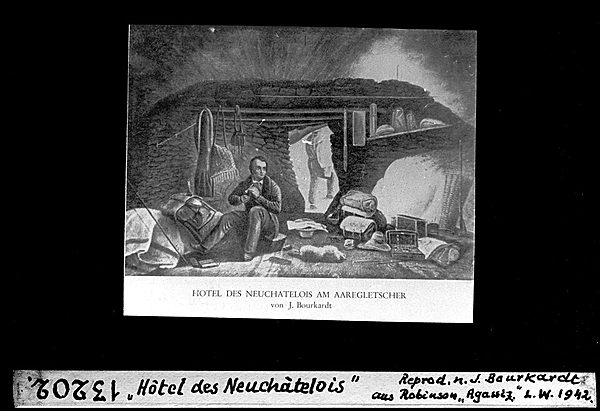
Louis Agassiz went looking for Hugi’s hut in August 1840 and found that it had disappeared entirely; after a long search the party turned up a bottle holding notes left by Hugi and by Agassiz. He built his own a little further up the moraine, under a slab of mica schist: a sleeping platform for six, hay mattresses, a stone floor, and the name L’Hôtel des Neuchâtelois chiselled in big letters on the north face of the rock, along with everyone’s names (SAC).
Then he did the experiment that broke his own theory. In September 1841 — at James Forbes’s suggestion, a detail the two of them would be quarrelling about for decades — Agassiz drove six stakes into the ice in a dead straight line across the glacier, fixing their positions against identifiable points on the surrounding mountains so there’d be no arguing later. He came back in July 1842. The line was a crescent. The stakes in the middle had run away downhill and left the ones near the valley walls behind.
That curve is the entire discovery. A slab sliding evenly downhill on its belly keeps its line straight. A crescent means the middle is moving faster than the sides — slipping past them, held back at the rock walls by friction, exactly the way honey moves through a pipe. Whether the ice is shearing through itself or sliding unevenly on its bed, a stake line alone cannot say. Agassiz had expected the opposite result and got this one instead.
What nobody could explain was how a solid does that. Forbes said the ice was simply viscous, like cold tar. John Tyndall said nonsense, it’s brittle — it fractures constantly and the fragments re-weld under pressure, a real effect called regelation. They were still fighting about it, and about who deserved the credit, when they died. Forbes was right about the behaviour and vague about the cause; Tyndall’s mechanism is genuinely real but can’t be the whole answer, because ice well below its pressure-melting point cannot melt and refreeze, and flows anyway.
The answer arrived in the 1950s, when John Glen put cylinders of ice in a cold room and squeezed them. Ice crystals are hexagonal, and they shear along their basal planes like a shoved deck of cards. Crucially, the response isn’t proportional — it’s roughly cubic. Triple the stress and you get about twenty-seven times the deformation rate. Drag at the walls is what holds a glacier’s edges back; the cubic law is why the profile from edge to centre steepens so dramatically, and Glen’s flow law is still the equation inside modern ice-sheet models.
One more thing about Forbes. On 20 August 1820 an avalanche on Mont Blanc swept three Chamonix guides — Pierre Balmat, Pierre Carrier and Auguste Tairraz — into a crevasse during Joseph Hamel’s expedition. Having measured how fast the ice ran, Forbes estimated when it would deliver them: about forty years. In August 1861 the snout of the Glacier des Bossons, three kilometres lower down the mountain, gave up a skull with the hair still on it, an arm, a hand, a foot. Joseph-Marie Couttet, seventy-two, who had survived the 1820 accident, identified his friends.
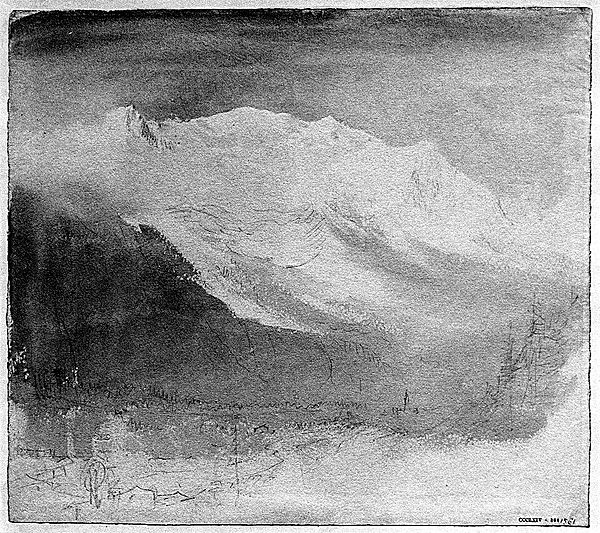
Hugi’s hut is gone. Agassiz’s boulder split in two in the summer of 1844 and the walls fell in. Tyndall hiked up to the site in 1856 and found the names weathering off the rock.
It was a temple of science now in ruins, and I a solitary pilgrim to the desecrated blocks.
— John Tyndall, The Glaciers of the Alps (1860), Project Gutenberg
The markers stood on the thing being measured; what made the numbers possible was sighting them against stable points off the ice. The motion itself was no news to anyone who lived under the glacier.
4 min read
Facts to Steal
Seven things worth retelling
-
In the summer of 1999 a cluster of GPS stations on southern Vancouver Island and in northwestern Washington quietly started moving the wrong way — west instead of east, for about two weeks, with no earthquake to account for it. Herb Dragert’s team worked out that a slab of the Cascadia subduction interface roughly 50 by 300 kilometres had slipped about two centimetres without shaking anything: the seismic moment of a magnitude 6.7 quake, released in slow motion. It turns out to happen on a timetable — roughly every 14 months in northwestern Washington and southwestern British Columbia (Miller et al., Science, 2002) — and nobody had any idea until the instruments got good enough to catch it (Dragert et al., Science, 2001).
-
For about two centuries, much of German-speaking Europe used money with an expiry date. At announced intervals, usually once a year, the coins in circulation were verrufen — called in — and anyone wanting to trade at the market had to swap them, typically getting nine new pennies for twelve old ones. That is a 25% annual tax on holding cash, and it went to the coinage-and-market lord (Münzkabinett, Staatliche Museen zu Berlin).
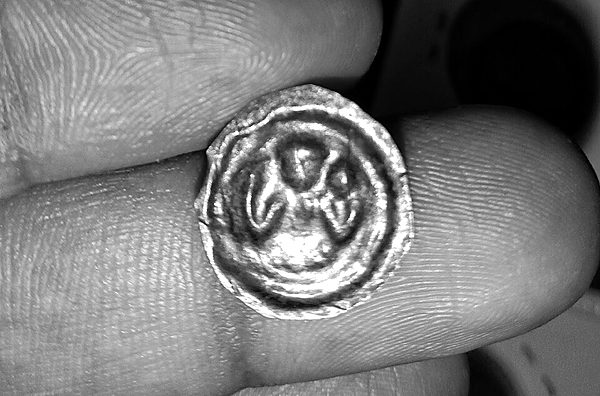
The coins made for this were bracteates — silver beaten so thin it could not survive a second die, so the image was hammered in from one side only and stood out backwards on the other (American Numismatic Society).
-
The one cipher that is provably unbreakable stopped being unbreakable because a Soviet pad plant ran the same pages twice. A one-time pad is secure only so long as the key is never reused; with the Germans advancing on Moscow, the plant producing the KGB’s pads turned out about 35,000 pages of duplicate key and sent the copies to far-apart stations, betting nobody would ever line two of them up. Arlington Hall lined them up — Richard Hallock caught the repeat in October 1943, Meredith Gardner read the first message in February 1946, and American analysts were still quietly picking apart 1940s Soviet cables until 1 October 1980 (NSA, Cryptologic Almanac: “VENONA: An Overview”).
-
A moth with eyes two millimetres wide steers by the stars. Bogong moths fly up to 1,000 km to particular caves in the Australian Alps they have never seen, guided by nobody — their parents were dead before they hatched. Tethered in a flight simulator under a projected night sky, with Earth’s magnetic field cancelled by Helmholtz coils, they held their heading; rotate the sky 180° and they turned around; scatter the stars at random and they lost the plot entirely (Dreyer et al., Nature, 2025).
-
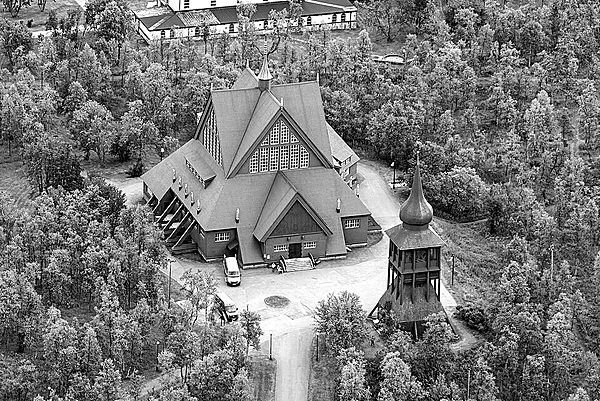
On 19 August 2025 a 672-tonne wooden church rolled down a road in Arctic Sweden at half a kilometre an hour. Kiruna’s church, forty metres wide, took two days to travel five kilometres, because continued mining toward and from the existing 1,365-metre main haulage level is deforming the ground beneath the old town. They set it down turned 180°, so the choir now faces west (LKAB).
-
Long stretches of the Swiss–Italian border are not lines but watersheds — the ridge crests of glaciers, firn and permanent snow — which makes the frontier legally dynamic. As the ice thins, the crest walks, and the border walks with it. In September 2024 the Swiss Federal Council approved the signing of an agreement pinning it down by hand at Testa Grigia/Plateau Rosa, Rifugio Carrel and Gobba di Rollin, to take effect once both countries sign (swisstopo).
-
The warship Vasa is manufacturing its own acid. Sulphur soaked into her timbers during 333 years on the floor of Stockholm harbour; iron from thousands of corroding bolts catalyses its oxidation, and in warm museum air it becomes sulphuric acid — potentially several tonnes of it as the sulphur converts (Sandström et al., Nature, 2002). Meanwhile the hull is settling about a millimetre a year, tracked twice annually across 400 measured points (Vasa Museum).
-
The lozenges that killed about twenty people in Bradford in 1858 were meant to be cut with plaster of Paris. A druggist’s untrained assistant, working from open unlabelled casks, handed over twelve pounds of arsenic instead; the sweets came out the wrong colour, so the wholesaler sold them cheap to a market trader. One analysis put nine grains of arsenic in a single humbug, twice the dose then reckoned fatal. Everyone charged was acquitted (Padgett, Journal of Victorian Culture Online).
6 min read
The Notory Art
A medieval machine for impossible learning
Sometime around 1301, a French monk studying canon law at Orléans worked out that he could not afford the textbooks. Nor the lectures — those cost money too. So he tried the other route, the one that was circulating quietly among university students all over Europe: a ritual that claimed to install the entire liberal-arts curriculum directly into your head, in a month by some promises, though the fully glossed procedure runs four months plus a fortnight of preparation.
His name was John, later provost of the abbey of Morigny near Étampes, and he is the only medieval person who left a detailed account of what it is actually like to run the Ars Notoria and have it work — in the sense that something definitely happened, just not the thing advertised.
Here is the operation, as the manuscripts give it.
You start at the new moon, because the whole thing is keyed to a lunar calendar any cleric could already read. On the fourth day of the moon you say the first of the general prayers, the triumphales. Then again on the eighth, twelfth, sixteenth, twentieth, twenty-fourth, twenty-eighth, and thirtieth. These earn you what the text calls the “generals” — memory, eloquence, understanding, perseverance — and they run the length of the month, interwoven with the work on any actual subject.
Then you go after a discipline. Grammar first, always. Grammar gets three figures, worked across the lunar month. A figure — a nota — is a diagram: geometry, columns of script, strings of names, all of it laid out to be looked at rather than read. The verb the text uses is inspectio. You look into it. Not at it. For the first fourteen days you look into the first figure twelve times, recite the words written into it twenty-four times, and the fully glossed procedure expects you to keep doing ordinary study alongside it — consulting books, attending instruction — across roughly fifteen preparatory days and four month-long phases, with the notae themselves contemplated chiefly in the fourth month. Then the dose shifts: through day twenty-eight the second figure joins the first, each looked into twenty times with thirty recitations of the orations, and on the last two days all three figures twelve times apiece with their orations thirty-seven times. Then rhetoric. Then dialectic, philosophy, medicine, music, geometry, mathematics, theology.
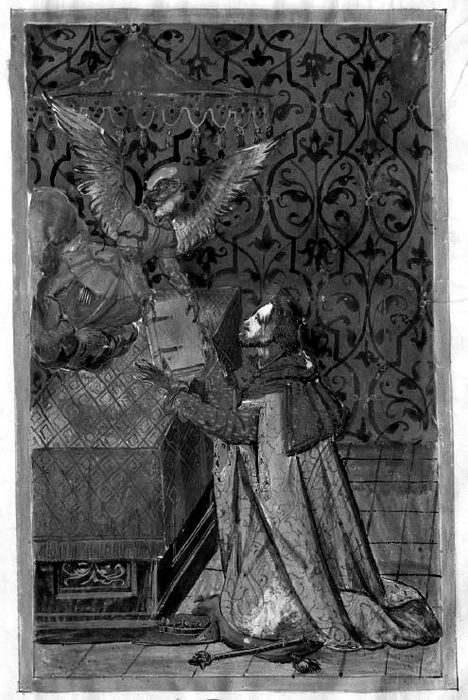
The words you recite are the interesting part, and the problem. They are not all Latin. Threaded through the ordinary Latin prayers are long strings presented as divine names preserved from older tongues — a mash of Greek, Hebrew and Aramaic, badly transmitted and by the thirteenth century mostly unparseable: Phos, Megale, Patir, Ymos, Ebel, Eber, Helioth, and hundreds more. You chanted them two dozen times a day without knowing what any of them meant or, more to the point, whom they addressed.
John completed one full cycle, ending the night before the new moon. That night he saw two men and sensed a third presence, took them for the Trinity, and was told that in eight days he would have a vision. He kept going. The visions continued and got worse — presences that demanded worship, and by his own account grew arrogant about it. His conclusion, arrived at slowly and against his own wishes, was that the invocations had been sitting inside the pious prayers the entire time, and that he had spent a month of disciplined devotion politely saying their names.
He did not quit. He went further into necromancy first, and only then renounced the lot and set out to build a clean replacement: the Liber florum celestis doctrine, a Book of Prayers written at Orléans between 1301 and 1308, with a Book of Figures added by 1310 and rewritten in 1315 because readers complained his diagrams still looked like necromancy.
Thomas Aquinas had already settled the matter a generation earlier, in the Summa:
The magic art is both unlawful and futile.
— Thomas Aquinas, Summa Theologica II-II, q. 96, a. 1, Dominican Fathers translation (1920)
Futile, he argued, because gazing at shapes and muttering strange words has no power in itself to cause knowledge; unlawful, because signs that God never instituted and men cannot understand are empty, and an empty sign that gets answered was a contract all along.
The sting: John’s clean version was confiscated and burned at Paris in 1323, per the Grandes chroniques de France, on the grounds that it revived exactly the thing he wrote it to replace. The burning did not suppress it. More than twenty copies survive across Europe, all of them later than 1323 though the book may already have been circulating before it, several annotated by people who clearly used them. The Ars Notoria he denounced survives in around fifty.
And the honest reading of the procedure is worse than the demons. Strip the invocations out and what remains is about four months of disciplined observance — fixed daily hours, sustained visual concentration — running alongside ordinary study from books and teachers. A man who did that would learn some grammar. He would simply have no way of telling which part had done it.
5 min read
The Uncanny Hour
The presence just behind your shoulder
The current ran for a few seconds and she said there was someone behind her.
She was twenty-two, with no psychiatric history, lying in a Swiss epilepsy unit with electrodes laid on the surface of her brain. The point of the exercise was housekeeping: before you cut out the tissue that causes seizures, you stimulate the neighbourhood contact by contact and note what each one does, so you know what you’d be destroying. One contact over the left temporoparietal junction did something the team had not seen before. Every time they energised it, a person arrived behind her shoulder — not seen, felt. Young. Silent. Very close.
And it copied her. When she sat, it sat. When they asked her to lean forward and clasp her knees, it reached around and held her, which she found unpleasant. The figure tracked her posture the way a shadow tracks a body, which is what the researchers eventually called it: an illusory shadow person, written up in Nature in September 2006 by Shahar Arzy, Margitta Seeck, Stephanie Ortigue, Laurent Spinelli and Olaf Blanke (443:287).
Here is the part that stays with you. She never worked out that it was her. She could see how closely it matched her own posture, and still did not recognise it as an illusion of her own body.
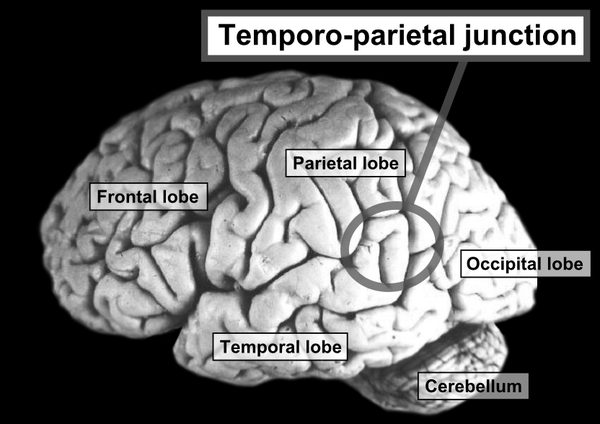
The mechanism is less mystical than the experience. Your brain maintains a running model of where your limbs are, which sensations belong to you, and what your next movement is about to feel like. The temporoparietal junction is one of the places where touch, balance, vision and proprioception get stitched into a single owned body. Disturb the stitching and a piece of the body-model ends up outside the body’s boundary — and the brain, presented with a body-shaped thing that isn’t filed as mine, does the obvious thing. It assigns it another owner.
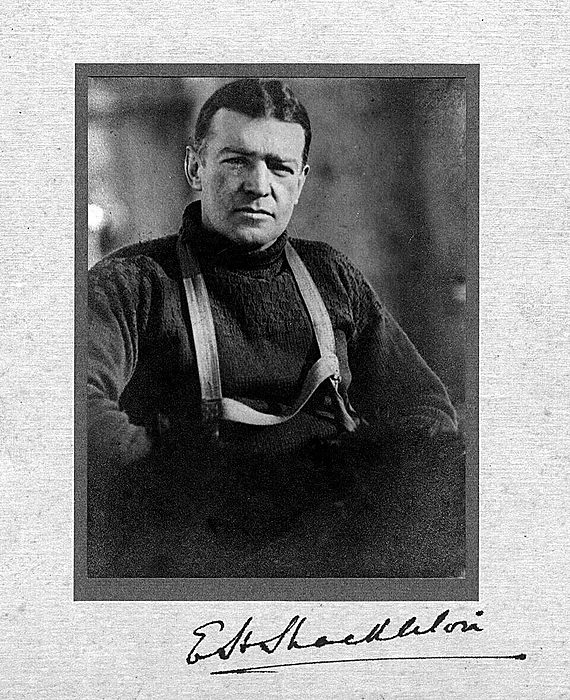
This is not a laboratory curiosity. It is a widely occurring experience reported in clinical and non-clinical settings alike, and the fittest, sanest people on record keep having it. In May 1916, Ernest Shackleton, Frank Worsley and Tom Crean crossed the uncharted interior of South Georgia in thirty-six hours to reach the whaling station at Stromness. Shackleton wrote it down three years later, in the flattest way imaginable:
I know that during that long and racking march of thirty-six hours over the unnamed mountains and glaciers of South Georgia it seemed to me often that we were four, not three. I said nothing to my companions on the point, but afterwards Worsley said to me, “Boss, I had a curious feeling on the march that there was another person with us.” Crean confessed to the same idea.
— Ernest Shackleton, South (1919), Project Gutenberg
Peter Suedfeld and Jane Mocellin combed the literature of extreme environments in 1987 and found the same visitor everywhere — solo sailors, high-altitude climbers, polar travellers, shipwreck survivors, prisoners in isolation (“The ‘sensed presence’ in unusual environments,” Environment and Behavior 19:33–52). The common factors are exhaustion, cold, monotony, sensory poverty — conditions that might disturb the body-model, though the review itself concluded the specific cause had never been properly investigated.
So in 2014 Blanke’s group tried to build one on purpose. They first mapped the brain lesions of twelve neurological patients who reported a felt presence and found damage clustering in insular, frontoparietal and temporoparietal cortex. Then they made a rig. A blindfolded volunteer moves a finger against a master robot in front of them; a second robot behind them reproduces that movement exactly, touching their back. Run in sync, it feels strange but obviously self-inflicted. Delay the rear touch by half a second and the presence walks in. Roughly a third of healthy volunteers spontaneously reported someone standing behind them; a few counted more than one; two were disturbed enough to ask that the experiment be stopped (Current Biology 24:2681).
Half a second. That is the whole apparatus of the haunting.
Be straight about what this doesn’t settle. The stimulation case is a single patient. The rig manufactures a presence, not a personality — nothing in it explains why the mountain’s companion is usually kind and the bedroom’s is usually not, or why Shackleton’s fourth man was also Worsley’s and Crean’s. Nobody has induced the thing the field reports actually turn on: the conviction that it knows something.
But the shape of the answer is now hard to argue with. The figure at your shoulder need not be an intruder. It can be you, filed under the wrong name.
4 min read
The Parlour Trick
A boomerang made from a postcard
Cut a postcard into two strips, cross them, and you can throw something across a room hard enough to make people flinch — and catch it again, in the same hand, two seconds later, without moving your feet.
The effect. You build it in front of them in about ninety seconds, out of whatever card is to hand: an index card, a menu, the back of a cereal box. Then you hold it up, snap it away with your wrist, and it goes — fast, spinning, straight at the far wall. Halfway there it banks, lies over, loafs back through the air as though it has changed its mind, and lands in your palm. There is no procedure to sit through. There is a bit of card, and then the card comes back.
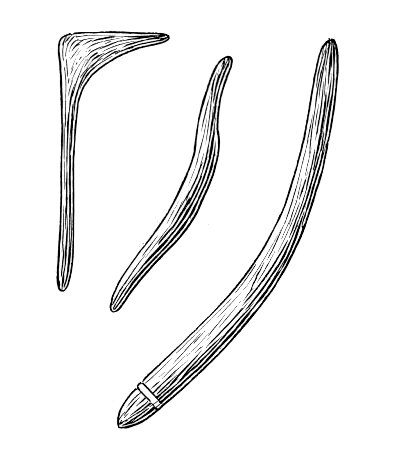
The secret is that there isn’t one. You have made a real returning boomerang, and returning boomerangs are far less exotic than people assume. Gilbert Walker measured a good wooden one for the Royal Society in 1897: about 80 cm long, one face more rounded than the other, and the arms twisted through roughly four degrees, like a right-handed propeller. Four degrees — or, Walker thought, just that rounding — is the entire trick; without one or the other he believed return impossible. Yours gets its lift another way: a gradual lengthwise curve along each arm, put in with a thumbnail. (Walker, On boomerangs, Phil. Trans. A 190, 1897; Cherniak, Indoor boomerang)
The handling.
- Cut two strips of stiff card about 12 cm long and 2 cm wide. Printer paper is too floppy; a greetings card or cereal box is perfect.
- Cross them at right angles, tape or staple the centre, then bend each arm gently upward from the middle. You have a four-armed X.
- Hold it by the tip of one arm, lightly, between thumb and forefinger. For a right-handed throw the curved faces should bow toward you; plane of the cross vertical, tilted maybe 15° with the top leaning away. Reverse the orientation and the spin for a left-handed throw.
- Toss it forward lightly, overhand, and snap your wrist down as it leaves your fingers. It needs both — a little forward speed and a lot of spin. Aim a little above the horizon. (Cherniak, Indoor boomerang)
- Don’t snatch at it on the return. Let it arrive, then close your hand.
Why it comes back, which is the better half of the fun: each arm is a wing, and the arm that happens to be on top is rotating forward and travelling forward, so it meets the air faster than the arm at the bottom. Lift goes as the square of airspeed, so the top is always being lifted harder than the bottom. That should tip the thing over. It doesn’t — because it is a gyroscope, and a torque on a spinning disc doesn’t tip it, it turns it, ninety degrees around from where you pushed. So it steers continuously into a circle; and because the disc is nearly vertical, nearly all that lift is pointing sideways, which is exactly the centripetal force it needs. It flies a circle because it is trying to fall over and can’t. (Australian Museum)
The out. If it flies straight and dies, check the faces are bowing toward you and restore the gentle lengthwise curve Cherniak specifies before touching anything else. If you want pitch, twist each blade slightly so its leading edge sits above its trailing edge — all four the same way round. Too much, twist less. If they demand a repeat, hand them the card: reverse the twist and the throw and it flies for a left-hander, which a carved wooden one won’t.
Honest difficulty: the making is trivial, the throw takes about six goes. Most Aboriginal boomerangs never returned at all — those were throwing sticks, meant to hit something and drop, and also digging tools, fire-starters and clapsticks. And if six attempts feels slow, Felix Hess spent seven years on the problem for his doctorate and handed Groningen a 555-page thesis about it in 1975.
4 min read
The Back Page
Riddle, storm swell, last speaker
A riddle from northern Luzon
In 1909 Frederick Starr, an anthropologist at Chicago, printed four hundred-odd Filipino riddles he had collected chiefly from schoolboys — each one in the language it arrived in, with a translation beside it. Number 6 is Gaddang. It takes four seconds to say and it is better than most riddles that take a paragraph.
If he sits down he is high ; if he stands up he is low.
— Frederick Starr, A Little Book of Filipino Riddles (1909), Internet Archive
The odd space before the semicolon is the book’s, not mine. Answer at the foot of the page — try it on somebody first.
The swell that gets there before the storm
Long before there is anything to see, the water changes. A slow, heavy, glassy swell comes in from one quarter on an otherwise ordinary day, and the old rule says a bad storm made it.
The rule is right, and you can check it with a watch. In deep Atlantic water, ordinary swell crests pass at roughly eight a minute. Swell thrown out by a hurricane is about twice as long — four a minute — and it can show up days ahead of the weather that made it.
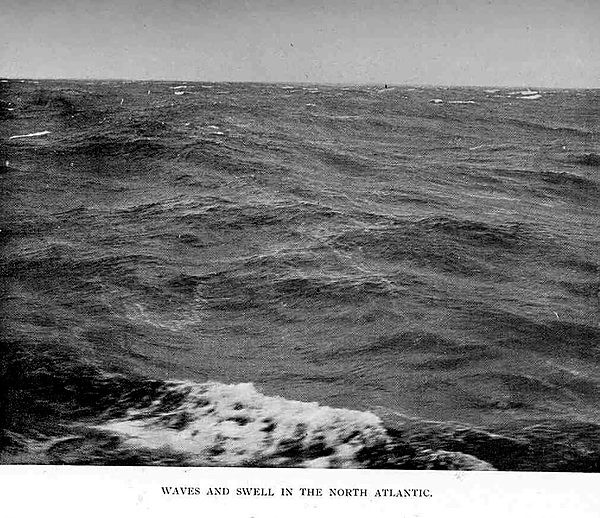
The mechanism is dispersion, and it gives you a number worth carrying. In deep water, wave energy travels at a speed set by the wave’s period: about 1.5 knots for every second between crests. So a fifteen-second swell moves at roughly 23 knots, while the hurricane that generated it typically crawls along at ten to fifteen. The swell outruns its own maker and knocks on your door first.
What it will not tell you is where the storm is now. The direction the swell comes from points at where the centre sat when those particular waves were born, which may be a day stale and hundreds of miles off — and once the swell reaches shoaling water, refraction bends it, so a bearing taken from the beach is less reliable still. Bowditch treats the swell as one indication among several, and calls the winds probably the best guide to the direction of the centre. (The American Practical Navigator, ch. 35 — a US government work.)
The epitaph that invented a fact
Dorothy Pentreath — Dolly — sold fish at Mousehole and was buried at Paul in Cornwall on 27 December 1777. Around 1789 an engineer from Truro named Thomson wrote a Cornish verse for her, published in 1806, announcing that she had died aged a hundred and two. She almost certainly hadn’t. The parish register has her baptised in May 1692, which makes her eighty-five. The verse won anyway; you will still find 102 in print.
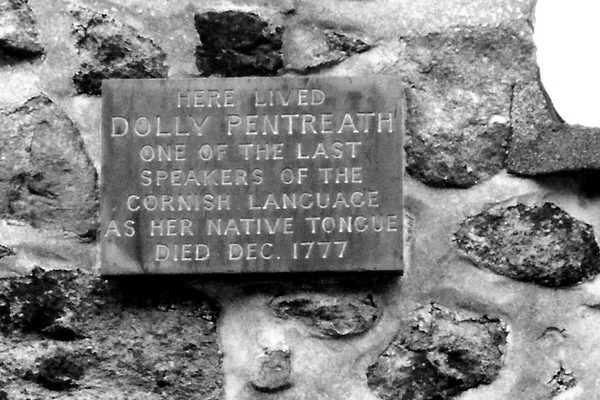
The larger claim is wrong too. In 1860 Prince Louis Lucien Bonaparte — Napoleon’s nephew, who spent his life and a good deal of money on dying languages — put up a granite memorial in Paul churchyard with the vicar, John Garrett. The stone hedges carefully: she is “said to have been the last person who conversed in the ancient Cornish, …” Careful, and still not true. The antiquary Daines Barrington held a letter dated 3 July 1776 from William Bodinar, a Mousehole fisherman, written in Cornish with Bodinar’s own English beside it, reporting that four or five people in that town could still speak it. Bodinar’s letter, not Dolly, is the last surviving prose in traditional Cornish — though he had learned it as a boy from old fishermen, so not natively. John Davey of Boswednack was still holding fragments when he died in 1891.
The memorial was reportedly mounted in the wrong part of the churchyard wall, and was moved forty-seven feet in 1887 to the presumed site of her grave. (Dictionary of National Biography, “Jeffery, Dorothy”; Bodinar’s letter)
What Dolly Pentreath actually was is the last recorded fluent native speaker of traditional Cornish. A language doesn’t stop on a date. It stops when the last person who could use it has nobody left to use it with — and by then, nobody is taking notes.
Answer to the riddle: a dog.